Gear Journal: Rods & Lines
Gear Journal: Rods and Lines:
As I’m organizing and putting my gear away from another successful season I thought it might be interesting to discuss some my thoughts on fly rods and fly lines. I’m going to make a few of these posts that highlight some of the gear I utilize and has proven effective on the water.
Rods:
The rod most of my anglers had in their hand this year was the Orvis Helios 4, 9 foot 8 Weight. Modern rods are becoming faster and stronger and an 8 weight packs a lot more punch then it used to. The majority of my fishing is done in shallow water and the 8 weight is subtle enough to be technical but also gives enough power to cast a bigger fly if necessary. I also mix in the 8.5 foot Helios 8 weight – this is a very strong rod, it has a stiffer butt section and requires a fast and compact casting stroke. For the right angler, it’s one of the best rods on the market in my opinion. I utilized a 7 weight a good amount this year when the fish were small and shallow. We ended up landing a Striped Bass close to 20 pounds on a 7 weight and although it took a little longer than usual to land it, it was released safely and with plenty of energy left. For deeper water and bigger class fish; the 8.5 foot Helios 10 weight was the rod of choice. It can smoothly cast a heavy sink line and is extremely light, with plenty of lifting power for a big fish in deep water. There’s a lot of rods out there right now that are very powerful, but they lack feel. In my opinion, the Helios does a nice job of packaging both together – it’s a castable rod for less experienced anglers and a serious tool for those with professional skill level.
Lines:
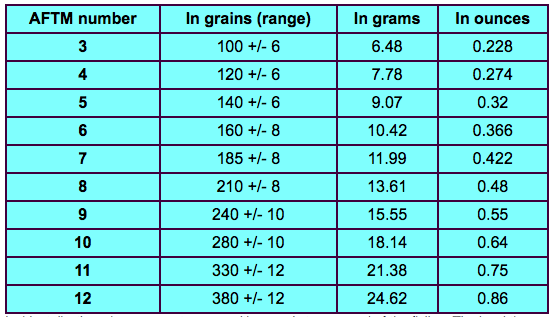
To me the most important factor in your fly fishing set up is the line. Line classification is really all over the place these days and simply going by what weight the box says is sort of a waste of time. You can spend over $1000 on a rod and if you put an improperly matched line on it, it’s not going to perform. If you look below you can see how AFFTA (American Fly Fishing Trade Association) classifies line weight. According to AFFTA an 8 weight line is between 202 – 218 grains – this is based off the first 30 feet of fly line. You will be hard pressed to find an 8 weight line that actually matches those parameters, and most modern fly rods won’t be very happy with a true to weight line. A line I use often is the Cortland classic taper 444 clear intermediate fly line. This line is actually a true to weight line, so on the 8 weight rod I mentioned above, I rig it with a 9 weight line that’s rated at 240 grains. Another line I like is the Cortland cold Stiped Bass intermediate, for this line an 8 weight line is 260 grains. Some lines are even more dramatic in their weight/grain combination. For example, Rio’s outbound short, a line often recommended for Striped Bass fishing, in an 8 weight is 330 grains. If you look at AFFTA’s chart in the gallery below, 330 grains should be an 11 weight line. Over weighted lines certainly serve a purpose in windy conditions, or casting really large flies, but ultimately a 330 grain line on an 8 weight should not be your everyday set up – yes you can gain some distance doing this but it will ultimately promote poor casting habits. There’s much more to line design like taper and how the grain weight is distributed but the above is a good starting point to think about line weight.
I am a big believer in a clear fly line. All our species here in the Northeast have moments where they are pretty agreeable – Striped Bass, Bluefish, False Albacore, and Bonito when riled up will pretty much eat anything you present properly. Most of the time however, this is not the case. A fully clear fly line has proven effective again and again for selective fish, especially in shallow water. At the very least, a less visible fly line is certainly not going to do any harm. Additionally, I always have at least one rod rigged with a full sink line – my choice is the Cortland Striped Bass Sink 8. A sink line can be a beneficial tool even in fairly shallow water, remember even if the line sinks 8 inches per second, if you start your retrieve as soon as the fly hits the water, it can only sink so much.
For reels, leaders, and flies there is a lot of personal preference and nuance so I’ll save that for another journal post. The big takeaway is finding the right line (consider a clear line), don’t be afraid of a sink line, and remember rods continue to get stronger, faster, and more capable. I really enjoying talking about fly rods so if anyone has any additional questions, free to reach out. (Photos by: Matthew Delorme)